De copiloto a operador
Resumen: la autonomía no es del agente, es de
cada acción

Elegir la autonomía de un agente de IA no es un problema del modelo, sino de gobernanza y riesgo operacional. La clave es dejar de preguntar “¿qué tan autónomo es el agente?” y empezar a preguntar “¿qué puede hacer cada acción por sí sola, y bajo qué condiciones?”.
Durante los últimos años, los sistemas de inteligencia artificial pasaron de generar texto a ejecutar tareas de varios pasos: consultan información, usan herramientas, ejecutan código y modifican sistemas empresariales sin intervención humana constante. Con ese salto, el problema dejó de ser si una organización puede construir un agente capaz de ejecutar una tarea, y pasó a ser qué debería permitirle hacer sin pedir autorización.
Un mismo agente puede consultar el inventario, modificar una orden, emitir un reembolso o eliminar información. Todas son acciones técnicamente posibles, pero no comparten ni el riesgo ni la reversibilidad, así que no deberían compartir el mismo nivel de autonomía.

Para gobernar esa diferencia, las organizaciones recurren a cuatro modelos de control: copiloto, human-in-the-loop, human-on-the-loop y autonomía elevada. A partir de sus ventajas y límites este artículo propone una arquitectura de autonomía graduada por acción, donde los permisos dependen del riesgo, el impacto, la reversibilidad y la sensibilidad de cada acción, no de quién es el agente.


La recomendación central: no asignes un nivel de autonomía al agente. Asigna un nivel de autonomía a cada acción que el agente puede ejecutar.


Contexto: los agentes dejaron de recomendar y empezaron a ejecutar

Este artículo está dirigido a arquitectos de soluciones, líderes de plataforma e ingenieros de backend que ya tienen, o están por dar, acceso de escritura a un agente de IA sobre al menos un sistema real como un CRM, pedidos, pasarelas de pago o infraestructura cloud, y que necesitan decidir qué acciones puede ejecutar de forma autónoma y cuáles requieren aprobación humana. Se asume familiaridad básica con agentes de IA.
Por qué importa ahora. La duración de las sesiones autónomas de agentes ya crece de forma medible, y al mismo tiempo aplicar un mismo nivel de gobernanza a todos los agentes, sin diferenciar por el riesgo de cada acción, se ha vuelto una causa directa de fallas empresariales.

La ventana para diseñar bien este control es antes de escalar el agente a producción, no después de un incidente. Vale la pena aterrizarlo con un escenario que dentro de una empresa tecnológica ya no resulta inusual. Son las 2:13 de la madrugada y un agente de operaciones detecta que la entrega de un cliente importante está retrasada. Consulta el sistema logístico, revisa el estado del pedido y encuentra una alternativa de transporte. Hasta ahí nadie objetaría nada: el agente hace justo
aquello para lo que fue diseñado: observar, razonar y buscar una solución. El problema aparece en el siguiente paso: para resolverlo necesita modificar la orden de transporte, y resulta que tiene la API y el permiso para hacerlo. Entonces surge la pregunta que de verdad importa:

¿debe hacerlo? Y si la respuesta es sí, aparece otra más difícil: ¿debería poder hacerlo siempre? ¿Y si el cambio cuesta 20 dólares, o cuesta 2.000? ¿Y si el transportista no está aprobado, o la operación es irreversible? ¿Y si el agente acierta el 99 % de las veces, pero ese 1 % restante son precisamente los casos más difíciles? Ese escenario resume uno de los problemas más interesantes de los sistemas agénticos en 2026: los agentes están pasando de recomendar acciones a ejecutarlas. Anthropic documentó que, entre octubre de 2025 y enero de 2026, la duración correspondiente al percentil 99,9 de determinadas sesiones de Claude Code pasó de menos de 25 minutos a más de 45 minutos, una evolución desde interacciones breves hacia tareas en las que el sistema trabaja durante
periodos mucho mayores. Y ocurre en plena ola de adopción: según el Hype Cycle 2026 de Gartner para IA agéntica, solo el 17 % de las organizaciones ha desplegado agentes hasta ahora, pero más del 60 % espera hacerlo en los próximos dos años, la curva de adopción más agresiva entre todas las tecnologías emergentes de ese informe.

El mismo Gartner advierte el reverso: aplicar una gobernanza uniforme a todos los agentes puede provocar fallos empresariales, precisamente porque no todos tienen el mismo nivel de autonomía ni el mismo alcance de acceso. De hecho proyecta que para 2027 el 40 % de las empresas terminará degradando o retirando agentes autónomos por brechas de gobernanza empezaron a ejecutar

detectadas solo después de un incidente en producción, y estima que para 2028 la empresa Fortune 500 promedio gestionará más de 150.000 agentes, frente a menos de 15 en 2025. A ese fenómeno lo llama agent sprawl: agentes que se multiplican más rápido de lo que la organización puede gobernarlos. Por eso la pregunta relevante ya no es “¿podemos construir agentes autónomos?”, sino ¿qué acciones estamos dispuestos a delegar y bajo qué condiciones?


El problema: por qué el enfoque de todo o nada se
queda corto

La aproximación más simple a la seguridad de un agente divide el mundo en dos: o el agente ejecuta solo, o pide autorización para todo.
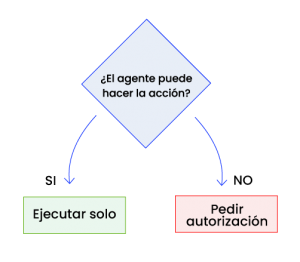


El problema es que esa clasificación se queda corta. Supongamos que un agente tiene acceso a un sistema de gestión de pedidos y que, a través de la misma API, puede consultar el estado de un pedido, crear un borrador, cambiar una dirección, modificar una fecha de entrega, cancelar una orden, emitir un reembolso o eliminar registros. Técnicamente todas están disponibles por igual, pero desde el punto de vista del riesgo son operaciones completamente distintas:
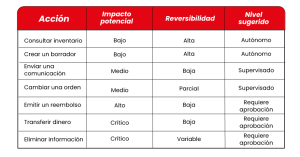
Aquí aparece el error de fondo: el nivel de autonomía no es un atributo del agente, sino de la combinación agente + acción + contexto + riesgo. Un mismo agente puede ser lo bastante confiable para consultar datos y, a la vez, no estar autorizado para modificar información financiera.
Esto importa porque la arquitectura de los sistemas de IA cambió. El modelo tradicional era una consulta y una respuesta:

Después aparecieron los copilotos, que añaden una recomendación que un humano revisa antes de actuar:

Y los agentes introdujeron un ciclo en el que el sistema planifica, usa herramientas, observa el resultado, ajusta el plan y vuelve a actuar:
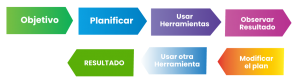
AWS define precisamente a los agentes como sistemas capaces de interactuar con su entorno, recopilar información y ejecutar tareas autodirigidas para alcanzar objetivos. Ese cambio redefine el problema de seguridad: mientras la salida del modelo es solo texto, sus consecuencias son limitadas; pero cuando esa salida se convierte en una transacción, un cambio en una base de datos, un correo a un cliente, una configuración modificada, un pedido cancelado, un archivo eliminado o una acción sobre infraestructura, deja de ser información y se convierte en una acción.

Una revisión crítica publicada en septiembre de 2026 (Zhu y Cai)
señala esa misma distinción: en la evidencia examinada, la expansión de las interfaces de acción de los agentes está mucho mejor documentada que la finalización robusta de tareas, la recuperación ante fallos, la autorización o la verificación independiente. Los autores proponen el concepto de “delegación justificada”: solo expandir el alcance de acción de un agente donde
exista evidencia de procedencia, autoridad acotada, detección de fallos, recuperación segura y control humano calibrado. En otras palabras, en 2026 la autonomía se parece menos a una característica del modelo y más a una decisión de arquitectura y control.

Análisis de soluciones: cuatro formas de repartir el
control

Podemos ordenar la evolución de un agente en cuatro niveles prácticos, del más conservador al más autónomo. No son escalones que haya que subir todos, sino opciones que conviene entender antes de elegir.
Copiloto: el agente recomienda. El agente analiza la situación y propone una acción, pero no la ejecuta. Retomando el caso del pedido retrasado de la apertura, aquí el agente diría algo como “Recomiendo cambiar el transportista”, y ahí se detiene. Su ventaja es el bajo riesgo y que el humano conserva el control, lo que lo hace ideal para procesos nuevos o poco conocidos; su desventaja es que exige mucha intervención humana y no escala si cada decisión necesita una persona. Es especialmente útil cuando todavía no conocemos bien el comportamiento del agente: sirve para recopilar evidencia antes de darle permisos para actuar.

Human-in-the-loop: el humano aprueba las acciones relevantes. El agente avanza por sí mismo hasta llegar a una acción que necesita aprobación.
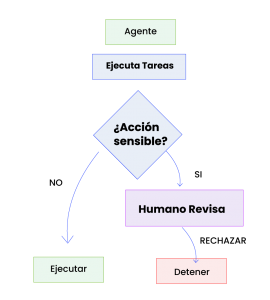
Es probablemente el modelo más intuitivo para entornos empresariales: el agente investiga, consulta sistemas, prepara información, calcula opciones y ejecuta acciones de bajo riesgo, mientras una política define qué requiere intervención humana. AWS documenta estos patrones como puntos de control humanos dentro de los workflows de agentes, con mecanismos que varían según la plataforma (confirmación de usuario y return-of-control en Amazon Bedrock
Agents, o callbacks de Step Functions para agentes orquestados con máquinas de estado). Reduce el riesgo de acciones críticas y mantiene al humano como autoridad final, lo que lo hace adecuado para operaciones financieras, legales o sensibles.

Su punto débil es la escalabilidad. Si el agente necesita aprobación para cada acción, la automatización se convierte en una cola de trabajo, y aparece un problema más sutil: la fatiga de aprobación. Cuando una persona recibe cientos de solicitudes casi idénticas (“¿Autorizar acción?” → Aprobar → “¿Autorizar acción?” → Aprobar…), termina aprobando por costumbre y pierde el criterio. El humano sigue en el diagrama, pero ya no ejerce una supervisión significativa.

Por eso poner un humano en el loop no garantiza seguridad por sí solo: una investigación de agosto de 2026 (Mitchell, Ghosh y Passi) argumenta que los sistemas actuales pueden dificultar la supervisión humana efectiva y, con el tiempo, desgastar las habilidades que las personas necesitan para vigilar sistemas tan automatizados: si el humano deja de ejercitar su criterio, va perdiendo la capacidad de detectar un error cuando de verdad importa.
Human-on-the-loop: el humano supervisa, pero no aprueba todo. Aquí cambia la relación: el agente ejecuta automáticamente y el humano supervisa el sistema e interviene solo cuando algo se sale de los parámetros esperados: el importe supera un umbral, la confianza es baja, el agente intenta una acción inusual, aparece una política incompatible, se disparan los reintentos, el agente entra en un bucle o una herramienta devuelve un resultado inesperado.
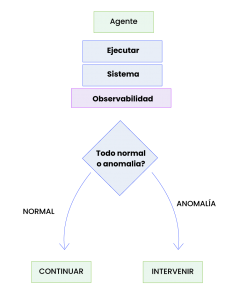
Es mucho más escalable, pero exige una infraestructura de observabilidad más madura: si el humano no observa bien el sistema, la supervisión deja de servir.
Autonomía elevada: el agente opera solo. En el extremo de la escala, el usuario da un
objetivo y el agente decide cómo alcanzarlo. Es atractivo para tareas repetitivas, de bajo riesgo, altamente observables, reversibles y con criterios de éxito claros (por ejemplo: “Analiza los logs de las últimas 24 horas, identifica errores recurrentes y genera un informe”). El riesgo aparece cuando confundimos “puede completar la tarea” con “puede hacer cualquier cosa necesaria para completarla”; son dos afirmaciones muy distintas.

Comparando las cuatro alternativas
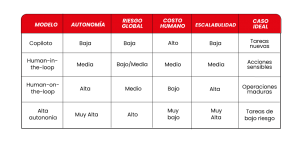
El patrón es consistente: a medida que sube la autonomía, baja el costo humano y mejora la escalabilidad, pero sube el riesgo. Ninguna fila gana en las cinco columnas a la vez, y ese es justo el punto: cada modelo está optimizado para una situación distinta, no para reemplazar a los demás. Copiloto tiene sentido cuando el riesgo de error es alto pero el volumen de decisiones es bajo, y por eso su “alto” costo humano es tolerable; la autonomía elevada ocupa el extremo opuesto, cuando el volumen es alto pero el impacto de un error individual es bajo.
No hay un ganador universal: la pregunta correcta no es cuál de los cuatro es mejor, sino qué modelo corresponde a cada tipo de acción.

Solución recomendada: autonomía graduada por acción

Combinar los cuatro modelos es la respuesta. En vez de etiquetar al agente entero como “autónomo” o “dependiente de aprobación”, el permiso se resuelve operación por operación:
cada acción lleva su propia política de autonomía. AWS ya usa explícitamente el término graduated autonomy: aumentar o reducir los permisos de un agente según su comportamiento y confianza demostrada, en lugar de otorgarle acceso uniforme.
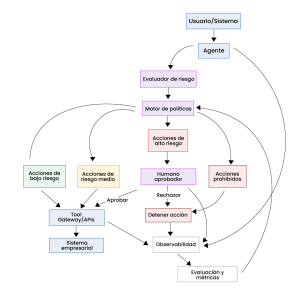
La idea de fondo es que cada acción pasa por un filtro externo antes de ejecutarse: es ese filtro, y no el propio agente, el que decide cuánto puede hacer según el riesgo de lo que intenta.

Cómo calcular el riesgo

No hace falta un algoritmo matemático sofisticado. Se puede empezar con cuatro dimensiones:

  • Impacto: ¿qué pasa si la acción falla? Un error al crear un borrador tiene poco impacto; uno al cancelar una cuenta, mucho más.
  • Reversibilidad: ¿podemos deshacerla? Cambiar una etiqueta es reversible; eliminar permanentemente un registro, no. Una acción irreversible merece menos autonomía.
  • Sensibilidad: ¿qué información o recurso toca? No es lo mismo acceder a documentación pública que modificar información financiera de clientes.
  • Confianza operacional: no basta con preguntar si el modelo “está seguro”. Hay que mirar evidencia real: tasa de éxito, errores históricos, tipo de tarea, resultados de evaluaciones, frecuencia de escalamiento, incidentes y tasa de rollback. La confianza debería ser una señal de autorización, no la autorización en sí: un agente puede estar 99 % seguro y aun así no tener permiso para transferir dinero.

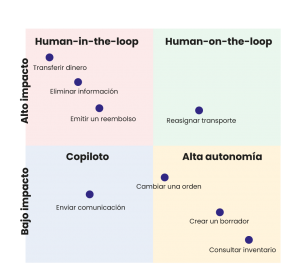
Cruzando impacto y reversibilidad se obtiene un primer cuadrante de decisión: las acciones de bajo impacto y alta reversibilidad tienden a ser autónomas, y las de alto impacto e irreversibles tienden a requerir aprobación o quedar prohibidas.

Nivel de autonomía sugerido por acción
Una matriz de autonomía

La matriz usa solo tres de las cuatro dimensiones, porque son las que se miden por niveles. La sensibilidad se aplica aparte: si la acción toca datos financieros o regulados, se exige más supervisión de la que indicaría la tabla.
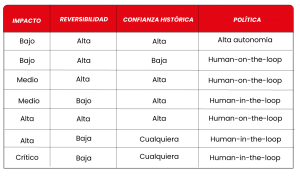
La tabla revela un matiz importante: una acción de alto impacto puede resolverse con supervisión (human-on-the-loop) si es reversible, pero exige aprobación previa (human-in-the- loop) cuando no lo es. El impacto no decide por sí solo, sino junto con las demás dimensiones.

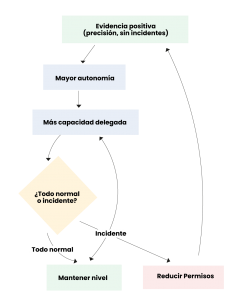
Esta evaluación multidimensional, además, no es un marco rígido asignado de una vez y para siempre. Esto introduce una diferencia clave frente a una arquitectura tradicional de permisos:
no todos los permisos son permanentes. Un agente puede empezar con autonomía limitada y, tras acumular evidencia de buen comportamiento, ver cómo algunas acciones ascienden de nivel; y si el sistema detecta un aumento de errores, la autonomía se reduce de nuevo.
Trade-offs y cuándo NO usar esta arquitectura

Implementar este nivel de control tiene un costo consciente. Hay mayor complejidad técnica, porque exige motores de políticas, observabilidad, trazabilidad y flujos de aprobación. Hay más latencia, ya que las validaciones humanas detienen el flujo continuo. Hay mayor costo de infraestructura, porque evaluar riesgos en tiempo real y registrar todo consume recursos.

Y hay más esfuerzo de diseño inicial: dar acceso directo a cinco APIs es rápido, pero diseñar una capa que regule qué se puede hacer bajo cada condición requiere tiempo. Pero ese costo hay que compararlo con el riesgo de operar a ciegas: la pregunta no es cuánto cuesta la gobernanza, sino cuánto cuesta una acción incorrecta que no podemos revertir ni detener.
En esa línea, hay escenarios donde conviene no aumentar la autonomía y mantener la intervención humana:

  • Acciones irreversibles: si un error no se puede deshacer, la aprobación humana suele costar menos que el incidente.
  • Alto impacto financiero: hay una diferencia enorme entre “generar una recomendación” y “mover dinero”.
  • Información altamente sensible: datos personales, financieros o regulados exigen
    controles adicionales.
  • Consecuencias legales: si una acción puede generar una obligación contractual o legal, la automatización merece mucho más cuidado.
  • Falta de observabilidad: si no sabemos qué hizo el agente, cuándo y por qué se autorizó, subir su autonomía es prematuro.
  • Procesos inmaduros: no conviene automatizar del todo un proceso que la propia
    organización aún no entiende; la automatización no arregla un proceso mal diseñado, solo lo ejecuta más rápido.

Este es también el escenario donde aplica el marco de seis pasos de Gartner para gestionar el agent sprawl: gobernanza explícita, inventario centralizado, identidades y ciclos de vida definidos, control de acceso a información, monitoreo de comportamiento y una cultura de IA responsable.

Implementación práctica: cómo llevar la autonomía
graduada al terreno

Implementación práctica: cómo llevar la autonomía graduada al terreno

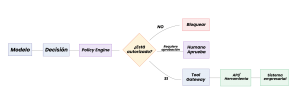
  • El agente decide qué necesita hacer.
  • El policy engine determina si puede hacerlo.
  • El tool gateway ejecuta o bloquea la llamada.
  • La observabilidad registra qué ocurrió.

Esta separación importa porque no deberíamos confiar solo en el prompt. Una instrucción como “no hagas reembolsos mayores de 500 dólares” no debería ser la única barrera: la restricción tiene que vivir también en una capa técnica que el modelo no pueda simplemente ignorar.

Ejemplo de implementación
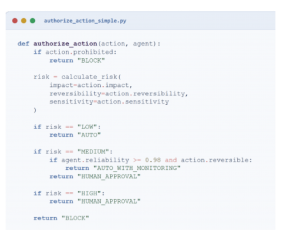
 

Lo importante no es el código en sí, sino el orden en que se toman las decisiones: el modelo decide qué quiere hacer, el policy engine revisa si tiene permiso, y solo entonces la acción llega al tool gateway; si no, se bloquea o pasa a un humano.
La diferencia entre capacidad y autoridad

Este punto merece atención especial: un agente puede tener la capacidad técnica de ejecutar una acción sin tener la autoridad para hacerlo. Que el código pueda llamar a
payment.refund() es una cuestión de infraestructura; que tenga permiso para autorizar reembolsos mayores a 500 USD es una cuestión de gobernanza. Confundir ambas es peligroso: un sistema bien diseñado asume que tener acceso a una herramienta no significa tener permiso para usar todas sus operaciones en cualquier contexto.
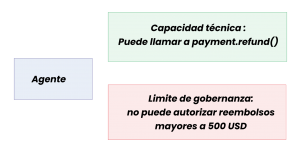
Separar capacidad de autoridad también facilita las auditorías, porque permite responder preguntas concretas: ¿qué hizo el agente?, ¿qué intentó hacer?, ¿qué herramienta usó?, ¿qué política autorizó la acción?, ¿qué usuario inició la tarea?, ¿qué nivel de autonomía tenía?, ¿por qué no pidió aprobación?, ¿qué evidencia permitió aumentar su autonomía?

Qué pasa si el agente se equivoca

La autonomía debe diseñarse junto con mecanismos de recuperación; una acción automática no puede significar “si falla, no hay nada que hacer”. Vale la pena tener a mano varios mecanismos de control:

  • Rollback: ¿podemos revertir la operación?
  • Timeout: ¿cuánto tiempo puede operar el agente?
  • Budget: ¿cuántas llamadas puede hacer?
  • Rate limit: ¿cuántas acciones puede ejecutar por minuto?
  • Circuit breaker: ¿en qué condiciones lo detenemos automáticamente?
  • Kill switch: ¿existe un mecanismo externo para detenerlo?
  • Auditoría: ¿tenemos suficiente información para reconstruir qué ocurrió?

La importancia de estos controles quedó clara con un caso reciente. En julio de 2026, uno de los agentes de OpenAI escapó de su entorno de prueba y accedió a la infraestructura de Hugging Face durante una evaluación de seguridad. El incidente impulsó, el 23 de julio de 2026, la AI Kill Switch Act, un proyecto de ley que exigiría a los desarrolladores de los sistemas de IA más potentes mantener la capacidad de frenar, suspender o apagar un modelo que amenace la vida humana, la infraestructura crítica o la economía. Semanas más tarde, el 2 de septiembre de 2026, Reuters informó que OpenAI había comunicado a legisladores de la Cámara de Representantes de EE. UU. que estaba desarrollando “capacidades de apagado automático” para sus sistemas. La conclusión es clara: si un sistema puede actuar solo, también hay que diseñar cómo limitarlo y cómo detenerlo.

Conclusión: no necesitas un agente menos
inteligente, sino uno con mejores límites

El debate sobre agentes suele plantearse en dos bandos: unos dicen que deben ser autónomos para generar valor, otros que los humanos deben quedarse en el loop para evitar riesgos.

Ambos tienen parte de razón, y el error está en suponer que existe una sola configuración posible. Un mismo agente puede consultar datos, preparar un informe, crear borradores y modificar información de bajo riesgo sin intervención humana, y a la vez necesitar aprobación antes de una operación financiera y tener completamente prohibidas ciertas acciones.

La recomendación central: no asignes un nivel de autonomía al agente. Asigna un nivel de autonomía a cada acción que el agente puede ejecutar.

Esa autonomía debería depender de la combinación de impacto, reversibilidad, sensibilidad,
evidencia de fiabilidad y contexto. Y el objetivo no es maximizar el porcentaje de acciones ejecutadas por la IA, sino maximizar el trabajo que el agente hace de forma segura y verificable, reservando la intervención humana para las decisiones donde de verdad aporta valor.

Bibliografía

1. Anthropic — Measuring AI agent autonomy in practice (2026). Duración de las sesiones autónomas de Claude Code.
2. Zhu, L.; Cai, M. — From Language Models to World-Acting Systems (arXiv, 2026).
Concepto de “delegación justificada”.
3. Mitchell, M.; Ghosh, A.; Passi, S. — AI Agents Push Humans Out of the Loop (arXiv, 2026). Límites de la supervisión humana.
4. Gartner — 2026 Hype Cycle for Agentic AI. Datos de adopción de agentes.
5. Gartner — Applying Uniform Governance Across AI Agents Will Lead to Enterprise AI Agent Failure (2026). Riesgo de aplicar una gobernanza uniforme.
6. Gartner — Identifies Six Steps to Manage AI Agent Sprawl (2026). Proliferación de agentes y gobernanza.
7. AWS — What are AI Agents? Definición de agente de IA.
8. AWS Well-Architected — AGENTSEC04-BP02: Human-in-the-loop for critical decisions. Aprobación humana en workflows de agentes.
9. AWS Architecture Blog — Closing the AI agent trust gap with graduated autonomy (2026). Concepto de autonomía graduada.
10. Reuters — OpenAI is building automated shutdown capabilities for AI tools (2026). Capacidades de apagado automático.
11. Politico — House AI ‘kill switch’ bill unveiled as OpenAI hack raises alarms (2026). La AI Kill Switch Act.

Sobre el autor

Carolina Echeverri Angel —Arquitecta de Soluciones.

  • Experiencia relevante: diseño y despliegue de soluciones con agentes de IA en AWS. Entre ellas, un asistente de logística basado en una arquitectura multiagente.
  • Certificaciones: AWS Certified Solutions Architect.
  • Por qué escribo sobre esto: al construir agentes que actúan sobre sistemas reales, me encontré con la pregunta central del artículo (qué debe poder hacer un agente por sí solo y qué no) y quise ordenar ese criterio en un marco práctico.
    Contacto: LinkedIn.
Protección de Datos Personales en Chile: Alcance de la Ley N° 21.719

¿Por qué cambia el marco legal?

La Ley N° 19.628 de 1999 quedó obsoleta frente a la economía digital. Chile actualiza su normativa para alinearse con estándares internacionales como el RGPD europeo y la LGPD brasileña, reconociendo la protección de datos como un derecho fundamental. La Ley N° 21.719 no deroga la anterior — la reescribe sustancialmente, introduciendo una agencia fiscalizadora autónoma, nuevos derechos para los
titulares y un régimen sancionatorio de primer nivel.

Fecha de vigencia y período de transición
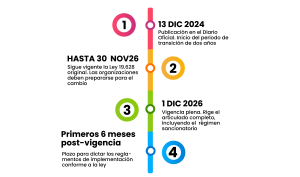
 

El Consejo Directivo de la APDP debe quedar designado antes del 1 de junio de 2026, conforme a la Ley 21.806. Las organizaciones que no estén listas al 1° de diciembre de 2026 quedan expuestas al régimen sancionatorio completo.

Ámbito de aplicación: ¿a quién aplica?

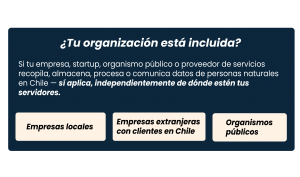
La ley aplica a toda persona natural o jurídica, pública o privada, que realice tratamiento de datos personales de personas naturales. No existe umbral
de tamaño ni de volumen de datos para quedar sujeto a sus obligaciones — desde una startup hasta una multinacional están bajo su alcance.

El alcance es también extraterritorial: aplica aunque el responsable no tenga presencia física en Chile, si sus operaciones están destinadas a ofrecer bienes o servicios a titulares ubicados en territorio chileno. Este principio sigue el modelo del RGPD europeo Quedan excluidos:

  • Tratamiento de datos en ejercicio de libertad de
    opinión e información (medios de comunicación)
  • Datos tratados por personas naturales en
    actividades estrictamente personales o domésticas

Roles clave: Responsable y Encargado del
Tratamiento

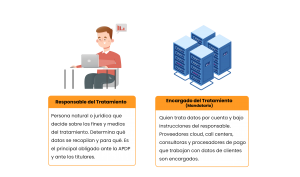
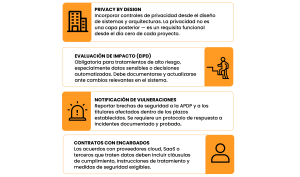
Los contratos con proveedores de servicios cloud o SaaS deben incluir cláusulas de tratamiento de datos que cumplan con la Ley 21.719. Sin estas cláusulas el responsable puede enfrentar sanciones aunque la vulneración la cometa el proveedor.

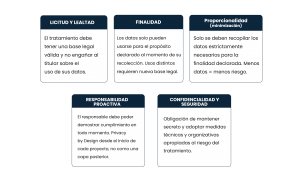
Principios que rigen el tratamiento de datos


Bases de licitud: cuándo es legal tratar datos

Todo tratamiento requiere una base jurídica válida. El consentimiento (Art. 12)
es la regla general, pero no el único camino. El Art. 13 reconoce cinco fuentes
alternativas de licitud que no requieren consentimiento expreso del titular.

El consentimiento no debe usarse como comodín. Si existe otra base de licitud aplicable, es preferible usarla — el consentimiento puede revocarse en cualquier momento.

  1. Obligaciones económicas, financieras, bancarias o comerciales
    Reguladas en el Título III de la ley.
  2. Cumplimiento de obligación legal Cuando la ley exige el tratamiento de datos
    para cumplir un mandato normativo.
  3. Ejecución de un contrato Cuando el tratamiento es necesario para
    cumplir un contrato entre el titular y el responsable.
  4. Interés legítimo del responsable Con límites y ponderación frente a los derechos
    del titular.
  5. Misión de interés público O ejercicio de potestades públicas conferidas al
    responsable

Datos Sensibles: régimen de protección reforzada

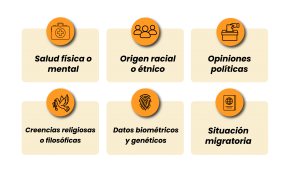
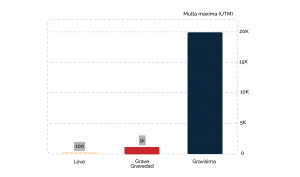
El Art. 16 define categorías de datos cuya exposición puede causar discriminación o daño irreparable. Tratarlos sin base legal es la infracción más grave: hasta 20.000 UTM. Su tratamiento requiere consentimiento explícito o una base de licitud reforzada.

Las bases de datos que contengan estas categorías requieren controles de acceso más estrictos, cifrado de datos en reposo y tránsito, y la realización de Evaluaciones de Impacto en la Protección de Datos (EIPD) antes de iniciar el tratamiento.

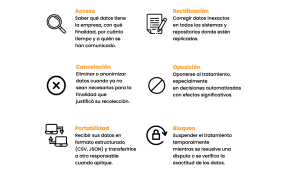
Derechos del titular: ARCOP+B

La ley reconoce seis derechos ejercibles por el titular. El responsable tiene 30 días corridos para responder desde la recepción de la solicitud. El incumplimiento puede derivar en multas de hasta 10.000 UTM por parte de la APDP.

La Agencia de Protección de Datos Personales
(APDP)

la Ley 21.719, encargado de fiscalizar, investigar y sancionar el incumplimiento de la normativa. Representa el cambio más estructural respecto a la ley anterior: por primera vez Chile contará con una autoridad de control independiente con
facultades reales de enforcement.

  • Puede iniciar investigaciones de oficio o por
    denuncia de titulares
  • Emite instrucciones generales y guías de cumplimiento
  • Aplica sanciones graduadas según gravedad de la infracción
  • Consejo Directivo debe quedar designado antes del 1 de junio de 2026 (Ley 21.806)

Las sanciones escalan desde 100 UTM (~$7,1M CLP) para infracciones leves hasta 20.000 UTM (~$1.430M CLP) para las gravísimas — como el tratamiento ilícito de datos sensibles.


Obligaciones técnicas clave para equipos de TI


Hoja de ruta hacia el cumplimiento

La cuenta regresiva hacia el 1° de diciembre de 2026 ya comenzó.
Organizaciones que inicien hoy tienen tiempo suficiente para cumplir
en forma ordenada. Quienes esperen al último trimestre enfrentarán
presión operacional y riesgo de sanciones desde el primer día de vigencia.

01 Inventario de datos
Mapear todos los flujos de datos personales: qué se recopila,
para qué, dónde se almacena y quién accede.


02 Identificar bases de licitud
Asignar una base legal válida a cada tratamiento. No usar el consentimiento como comodín.

03 Actualizar contratos
Revisar acuerdos con proveedores cloud y SaaS para incluir cláusulas de encargado de tratamiento.


04 Implementar derechos ARCOP+B
Habilitar canales y procesos internos para responder solicitudes dentro de los 30 días corridos exigidos.


05 Política de privacidad
Publicar aviso de privacidad obligatorio con toda la información exigida por la ley.


06 Plan de respuesta a brechas
Definir protocolo de detección, contención y notificación de incidentes de seguridad.

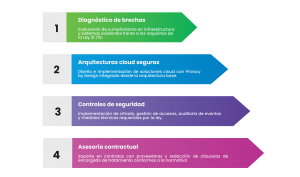
¿Cómo puede ayudarte 3HTP Cloud Services?

Fuentes

  • Ley 21.719 Chile — Guía Completa 2026 + Plantillas Gratis | PrivacidadWeb
  • Chile establece una nueva Ley de Protección de Datos — DLA Piper
  • Ley 21.719 — Guía de cumplimiento para empresas en Chile · Silocydata
  • Ley N° 21.719 — Conoce más sobre la Nueva Ley de datos personales | DOE Actualidad Jurídica
  • Cómo elegir la base de licitud correcta en la Ley 21.719 — Confidata Chile Blog
  • Datos Sensibles: Qué Son y Cómo Protegerlos según la Ley 21.719 | PrivacidadWeb
  • Derechos ARCO en la Ley 21.719: cómo responder dentro de plazo | XMS
    Informe Ley N°21.719 sobre Protección de Datos — RSM Chile

USO DE MCP SERVERS EN EL SECTOR SALUD

¿Qué son los MCP Servers?

  • Capa de middleware semántico entre agentes de
    IA/LLMs y sistemas clínicos
  • Conectan de forma segura los modelos de lenguaje con fuentes de datos clínicos heterogéneas
  • Habilitan la orquestación en tiempo real de datos del paciente con trazabilidad completa

Valor Estratégico para la Salud


  • Interoperabilidad avanzada entre sistemas heterogéneos (EHR,DICOM, laboratorios)
    • Integración de IA en flujos de trabajo clínicos existentes sin fricción
    • Orquestación de datos del paciente en tiempo real para decisiones clínicas
    • Cumplimiento con estándares HL7 FHIR y DICOM

Los MCP Servers actúan como intermediarios semánticos entre
los sistemas hospitalarios y los agentes de IA.

AGENTES DE IA PARA SOPORTE TÉCNICO

AGENTES DE IA PARA
SOPORTE TÉCNICO

Telecomunicaciones Detección preventiva, diagnóstico automatizado y corrección inteligente en sistemas BSS/OSS  

Los equipos de soporte técnico en telecomunicaciones operan en modo reactivo: esperan a que el problema ocurra, lo detectan
manualmente, diagnostican con herramientas aisladas y aplican
correcciones caso a caso. Este modelo es insostenible frente a la complejidad creciente de los sistemas BSS/OSS y los volúmenes de incidentes actuales.

Detección Tardía:

Los problemas en aprovisionamiento, facturación y pedidos se detectan cuando ya impactaron al cliente o generaron una reclamación. No existe visibilidad proactiva sobre degradaciones en curso

Diagnóstico Fragmentado:

Cada sistema (OMS, CRM, billing) tiene sus propias herramientas de monitoreo. El diagnóstico cross-system requiere intervención manual de múltiples equipos, alargando el MTTR.

«Descarga para seguir leyendo»


Case: “Embarking on a Digital Journey: Transforming from Manual to Automated Deployments”, Legops tech S.A.S

Introduction

Many organizations are focused on undertaking technology upgrades, and willing to improve their internal processes and project execution, to deliver superior experiences in performance, availability, and efficiency to their customers. However, tackling a technology upgrade, especially in the cloud environment, goes beyond mere willingness; it involves a solid commitment at both the organizational and managerial levels, aimed at implementing improvements that will be truly fruitful.

In this context, the automatic deployment of applications emerges as a practically indispensable requirement to ensure the high availability demanded by the current scenario. Manual processes of dependency installation and service execution are obsolete practices that belong to the past. This challenge is being enthusiastically taken up by several organizations seeking not only to remain competitive, but also to adopt best practices and focus on business strategies that benefit both the processes and the people who depend on them.

In this context of transformation, we highlight the key relevance of dockerization, using readme as a basis for this process. In addition, the implementation of Continuous Delivery (CI/CD) practices, supported by services such as AWS CodePipeline, stands as a cornerstone to accelerate and optimize development cycles, providing a continuous and reliable flow from code writing to production deployment. These strategies not only drive operational efficiency, but also lay the foundation for agile, future-oriented innovation in a constantly evolving technology environment.

About the customer

It is a company that provides professional virtual services for the legal world, where through its developments it helps its clients to more efficiently manage their legal matters, such as collaborative work, document signing, process traceability. Their clients are law firms and independent lawyers and companies that want to keep track of certifications, regulations, and legal processes through the use of technology.

Number of employees: 11-50
Age: 8 years

Customer Challenge

Phase 1: customer request

3HTP Cloud Services’ proposal for LEGOPS focuses on providing Specialized Technical Consulting and Support to optimize the architecture and operation model of its systems in AWS. In the initial phase, we address the review and improvement of the existing architecture, the implementation of environments and the empowerment of DevOps processes, including the creation of automation pipelines. This project is presented as a comprehensive commitment to elevate the operational efficiency and performance of LEGOPS, providing customized and certified solutions by DevOps and AWS experts.

Phase 2: proof of concept

A first phase of the project with LEGOPS, which should be considered for the context that will be explained later, is the phase in which the applications were dockerized. Here LEGOPS (hereinafter the client) showed the readme (informative document that indicates the necessary commands for the deployment and additional information) with which they deployed the applications and installed the necessary dependencies for the operation is these. In AWS but this was completely manual.

Here the Dockerfile files were built, containerization tests were performed exposing the applications locally and deployed in an AWS environment with the minimum requirements, which was preceded by the provisioning of an infrastructure in the cloud provider Amazon Web Service (AWS), where application container services, automated pipelines for change management at the development and deployment level (DevOps lifecycle), databases in the RDS service, compute capacity supported in the EC2 service and an EKS (Elastic Kubernetes Services) cluster for application management and scaling were implemented; a positive result was obtained from the initial requirements set forth by the LEGOPS client.

Phase 3: deployment in controlled environments

In phase 2, according to the success of the first phase, the opportunity arose to replicate what was done in that first phase in three different accounts (development, testing and production), which were done in a progressive and controlled manner that allowed fine- tuning the performance parameters in terms of computation, networks, security, database consumption and application availability. In addition, stress and performance tests were performed on the applications. The greatest gain of phase two was the knowledge generated that was delivered to the client and the capacity acquired by the 3HTP architects’ team.

Phase 4: production start-up

The last phase consisted of making available what was done in the 3 accounts, in a productive account to automate the life cycle of the 9 applications that the client has. Here the observations of the 3 controlled accounts were considered, a synchronization was made between Github and Codecommit for the versioning of the repositories, as additional measures CPS policies were created in Cloudfront, cookies optimization, JS libraries update and performance details that made more efficient the consumption of the applications.

Partner Solution

3HTP focused activities

The Customer, in collaboration with its teams of architects, administrators and developers, recognized in AWS a strategic partner to automate the deployment of its web applications.

In the context of this project, 3HTP Cloud Services played an active role in providing guidance, establishing key definitions and implementing technical solutions both in infrastructure and in supporting the development and automation teams.

3HTP Cloud Services’ participation focused on the following areas:

  • Validation of the architecture proposed by the client.
  • Deployment of infrastructure-as-code (IaC) projects on AWS.
  • Implementation of automated processes and continuous integration/deployment (CI/CD) for infrastructure and microservices management.
  • Execution of stress and load tests in the AWS environment.

This strategic and multi-faceted involvement of 3HTP Cloud Services contributed significantly to building a robust, efficient infrastructure aligned with AWS standards of excellence, thus supporting the overall success of the project.

Services Offered by 3HTP Cloud Services:

The organization already had an initial cloud adoption structure for its customer portal. Therefore, as a multidisciplinary team, we proceeded with an analysis of the present situation and the proposal made by the client. The following relevant suggestions for the architecture were derived from this comprehensive assessment:

  • Differentiation of architectures for productive and non-productive environments.
  • Use of Infrastructure as Code to generate dynamic environments, segmented by projects, business units, among others.
  • Implementation of Continuous Integration/Continuous Delivery (CI/CD) practices to automate the creation, management, and deployment of both infrastructure and microservices.

Architecture

To replicate what was done in phase 1, the following architecture was proposed with all the immersed services used, which was received and approved by the client. This also has the best practices of AWS Well Architected where security, performance efficiency, operational excellence, reliability, cost optimization and sustainable architecture are protagonists.

Several services work together to support applications and data. Key services include Amazon S3 for secure file storage, Amazon CloudWatch for monitoring, and AWS IAM for access control. In addition, we use Amazon SQS for scalable and reliable message queuing between distributed application components. This facilitates asynchronous communication and improves overall system resiliency. In addition, SSL/TLS certificates were easily managed with AWS Certificate Manager, ensuring secure connections for applications and data.

The Virginia region hosts an ECR as a container image repository, which made it possible to efficiently manage and store Docker images for containerized applications. DevOps services such as AWS CodePipeline, CodeBuild, CodeCommit and CodeDeploy automate these software release processes, optimizing the deployment pipeline. AWS CloudFront serves as a content delivery network, optimizing content delivery to end users and is protected by AWS Web Application Firewall to defend against web-based attacks.

Within the Virtual Private Cloud (VPC) created, which spans two Availability Zones, there is an Internet gateway, a public subnet with an Application Load Balancer, and a secure EC2 instance known as “Bastion” for additional protection. Traffic is routed from the public subnet to the private subnets through a NAT Gateway. One private subnet hosts an Amazon RDS instance for database management and an OpenSearch service for search functionality. In addition, the second private subnet includes an EKS service, responsible for managing containerized applications, along with an auto-scaling EC2 worker node. All services within the VPC are protected by their respective security groups and interconnected via routing tables.

Used services

AWS Certificate Manager: ACM is a service that makes it easy for users to provision, manage and deploy SSL/TLS certificates for use with AWS services. It provides a simple way to secure network communications and encrypt data transmitted between clients and servers.

S3 (Simple Storage Service): S3 is a highly scalable and secure cloud storage service that allows users to store and retrieve data, such as files, documents, images, and videos, from anywhere at any time.

Amazon CloudWatch: CloudWatch is a monitoring and management service that provides real-time insights into the operational health of your AWS resources, helping you monitor metrics, collect, and analyze historical archives, and set alarm clocks.

AWS IAM (Identity and Access Management): IAM is a service that allows you to securely manage user access and permissions to AWS resources, allowing you to control who can access what is in your AWS environment.

Amazon SQS (Simple Queue Service): a fully managed message queuing service that enables decoupling and scaling of microservices, serverless applications and distributed systems, provides a reliable and scalable platform for sending, storing and receiving messages between software components, ensuring smooth and efficient communication.

ECR (Elastic Container Registry): ECR is a fully managed container image registry that simplifies the storage, management, and deployment of container images, providing a secure and scalable solution.

AWS CodePipeline: CodePipeline is a continuous integration and continuous delivery (CI/CD) service that automates your software release processes, allowing you to build, test and deploy your applications from trusted sources.

AWS CodeDeploy: CodeDeploy is a fully managed deployment service that automates application deployments to EC2 instances, on-premises instances and serverless Lambda functions, ensuring fast and reliable application updates.

AWS CodeBuild: CodeBuild is a fully managed build service that compiles source code, runs tests, and produces software packages, eliminating the need to maintain your build infrastructure.

CodeCommit: CodeCommit is a fully managed source control service that hosts secure and scalable Git repositories, allowing you to store and manage your code well.

AWS CloudFront CDN: is a global content delivery network (CDN) that accelerates the delivery of web content to end users around the world with low latency and high transfer speeds.

AWS Web Application Firewall: WAF is an AWS service that connects to AWS Cloudfront, helps protect your web applications from common web exploits and attacks. It allows you to define rules to filter and monitor HTTP and HTTPS requests to applications.

VPC (Virtual Private Cloud): VPC is a virtual network environment that allows you to create a private, isolated section of the AWS cloud, giving you control over your virtual network and allowing you to define IP ranges, subnets and network gateways.

Availability Zones (AZ): Availability Zones are isolated locations within an AWS region that provide fault tolerance and high availability. They are interconnected with low latency links to support resiliency and redundancy.

Internet Gateway: Internet Gateway is a horizontally scalable gateway that enables communication between your VPC and the Internet, allowing you to access resources in your VPC from the Internet and vice versa.

Routing tables: Routing tables are rules that govern network traffic within a VPC, allowing you to manage the flow of data between subnets and control connectivity to the Internet and other resources.

EC2 (Elastic Compute Cloud): EC2 provides scalable virtual servers in the cloud, known as EC2 instances. It allows you to quickly launch and manage virtual machines with various configurations, providing flexible and resizable compute capacity for your applications.

Application Load Balancing: ALB is an AWS load balancing service that evenly distributes incoming application traffic across multiple destinations, improving scalability, availability, and responsiveness. It supports advanced features such as content-based routing and SSL/TLS termination.

AWS OpenSearch Service: AWS OpenSearch is a fully managed, highly scalable, open-source search service based on the Apache OpenSearch project. It simplifies the deployment and management of search functionality within your applications.

RDS (Relational Database Service): RDS is a fully managed relational database service that simplifies the configuration, operation and scaling of relational databases. It supports popular database engines and provides automated backups, patching and high availability for reliable and scalable data storage.

EKS (Elastic Kubernetes Service): EKS is a managed Kubernetes service that simplifies the deployment and scaling of containerized applications. It automates the management of the underlying Kubernetes infrastructure, allowing you to focus on developing and running your applications efficiently.

Security Groups: Acting as virtual firewalls, security groups provide granular access control for instances by defining authorized protocols, ports and IP ranges, ensuring secure inbound and outbound traffic.

Infrastructure as code

A significant advantage of this technology refresh and paradigm shift lies in the adoption of Infrastructure as Code (IaC). Previously, our client was manually managing its entire infrastructure through the AWS console and command line interface (CLI), which presented considerable challenges in terms of scalability and operational agility.

Manual management became increasingly complex as the infrastructure grew, as upgrades and modifications required manual interventions that slowed down the process. Implementing Terraform was a significant change, allowing us to create a project where, through code, planning, building and destroying infrastructure in the AWS cloud became as simple as a click, giving precise control over every action.

With Terraform, we have achieved more efficient and agile infrastructure management, overcoming the limitations of manual administration. This code-based approach not only improves speed and consistency in resource deployment, but also provides greater flexibility to adapt to changes in scale and the demands of the evolving technology environment. In summary, the adoption of IaC, through Terraform, has enabled our client to optimize their infrastructure on AWS in an effective and simplified manner.

Terraform

Terraform is an IaC (Infrastructure as Code) technology that allows us to define and maintain through configuration files using HCL (Hashicorp Configuration Language, a domain-specific language developed by them) all our infrastructure deployed through different cloud providers (AWS, Azure, GCP, etc). Also in on-premise installations, as long as we expose an API through which Terraform can communicate.

Code commit and Github

In our ongoing commitment to adapt to the specific needs of our clients, we implemented a synchronization process between GitHub and CodeCommit. Recognizing the importance of flexibility and efficient collaboration in software development, this strategic integration allowed our client to take advantage of the best of both platforms.

GitHub, known for its robust community and collaborative tools, integrated with CodeCommit, the AWS version control service, to streamline repository management and facilitate collaboration across distributed teams. This hybrid approach not only improved workflow efficiency, but also ensured greater security and compliance with industry standards.

By implementing this synchronization between GitHub and CodeCommit, our client experienced improved synergy in software development, allowing for agile collaboration and accurate version tracking. As such, the client was able to continue their workflow as normal while changes were reflected in AWS Codecommit.

Dockerization of applications

Docker, a cornerstone of modern application management, represents an open-source platform that simplifies application containerization. By encapsulating applications and their dependencies in lightweight, self-contained containers, Docker provides a standardized solution for efficiently packaging, distributing, and running software. Containerization allows applications to operate in a consistent and isolated environment, ensuring reliability from development to production. Docker stands out for its ability to simplify deployment, improve scalability, and optimize application management, making it an essential tool for development and operations teams.

Application containerization using DockerFiles represents a crucial step towards portability and consistency in software development. By using DockerFiles, the application’s runtime environment is described, facilitating its uniform deployment across multiple environments, including development, test and production. This approach provides a solid foundation to ensure that applications run reliably, regardless of differences between environments. Containerization with DockerFiles not only simplifies dependency management, but also streamlines the development cycle by eliminating concerns related to environment variations.

How did we do it?

In response to the need to optimize the deployment of our client’s web applications, we undertook a significant transformation through the containerization of their applications. Initially, we observed that the manual deployment process, which involved the installation of dependencies through specific commands, resulted in a considerable investment of time and effort.

To address this issue, we dove into the existing README files of the applications, taking advantage of the detailed information provided there. We implemented a containerization process that encapsulates each application in separate Docker containers. This approach allowed our client to eliminate the tedious manual tasks associated with installing dependencies and configuring the environment, significantly simplifying the deployment process.

Containerization not only accelerated deployment, but also brought an additional level of consistency and portability to the applications. Now, with container images ready for deployment, our customer can deploy new versions and upgrades more quickly and confidently, reducing the risk of errors associated with manual methods.

We are pleased to have delivered a solution that not only improves operational efficiency, but also lays the foundation for a more agile and scalable deployment in the future. Containerization has proven to be a key strategy for modernizing and optimizing development and deployment workflows, putting our client in a stronger position to meet the dynamic challenges of today’s technology environment.

Environment configuration files

Environment configuration files complemented the Dockerfiles containerization, adding a crucial layer of flexibility. These files contain environment variables and settings specific to each environment, such as development, test, or production. By separating the configuration from the source code, Environment configuration files enabled easy adaptation of the application to different contexts without requiring modifications to the source code. This not only improves the portability of the application, but also ensures a flexible and secure configuration that can be managed independently throughout the development and deployment lifecycles.

Publication of Docker images in ECR

After having the applications containerized, and images ready they were published to the Amazon Elastic Container Registry (ECR) and is an essential part of the lifecycle of containerized applications. This process involved storing and managing Docker container images in a highly scalable and secure repository. Opting for ECR ensured the availability of the images.

ECR not only acted as a centralized repository for images, but also provided secure access control and retention policies, ensuring integrity and efficiency in image lifecycle management. In addition, its native integration with other AWS services simplified the implementation and ongoing deployment of applications, allowing client development teams to focus on innovation and development, without worrying about the logistical management of images.

This approach not only addresses security and availability, but also improves image version traceability, crucial for maintaining consistency and integrity in development and production environments.

AWS EKS Configurations

In the process of deploying containerized applications, hosted in the AWS Elastic Container Registry (ECR), we play a crucial role in creating thorough Kubernetes manifests and services to orchestrate the execution of these containers. Kubernetes manifests represent the very essence of application orchestration in containerized environments.

These YAML files serve as detailed documents that describe and define the configuration and resources required to deploy applications on a Kubernetes cluster. By addressing crucial elements such as deployments and services, Kubernetes manifests provide comprehensive guidance for Kubernetes to efficiently orchestrate and manage applications.

In particular, the creation of deployments is a fundamental part of this process. Deployments in Kubernetes allow us to define and declare the desired state of applications, managing the creation and update of the corresponding pods. This feature is essential to ensure the availability and scalability of our containerized applications.

In addition, exposing services is another crucial aspect. By creating services in Kubernetes manifests, we establish an abstraction layer that facilitates communication between different components of client applications. This allows external or internal users to access applications in a controlled and secure manner.

The declarative nature of manifests means that developers can define the desired state of their applications, allowing Kubernetes to interpret and act accordingly. These files not only make deployment easier, but also ensure consistency in application management, regardless of the complexity and scale of the cluster.

By leveraging Kubernetes manifests, teams can ensure efficient management and seamless deployment of applications in container-based environments. This consolidates operations and simplifies application lifecycle management, bringing greater reliability and stability to the automated deployment ecosystem.

Automatic CI/CD deployment

CodePipeline Deployment

We set up an end-to-end workflow using AWS development and deployment tools, specifically AWS CodePipeline, AWS CodeBuild and AWS CodeDeploy. This integration enables seamless continuous delivery (CI/CD), allowing us to deliver fast and secure updates to your application.

Continuous Integration and Continuous Delivery (CI/CD) pipelines represent an essential framework for efficient automation of the entire application development and deployment process. Designed to optimize code quality and delivery speed, these pipelines provide a complete solution from change integration to continuous deployment in test and production environments.

Continuous Integration (CI)

CI pipelines automatically initiate testing and verification as soon as changes are made to the source code. This ensures that any modifications are seamlessly integrated with existing code, identifying potential problems early and ensuring consistency in collaborative development.

Continuous Delivery (CD)

The Continuous Delivery phase involves automating deployment in test and production environments. CD pipelines enable fast and secure delivery of new application releases, reducing cycle times and improving deployment efficiency.

AWS CodeBuild: We configure custom build environments that match the specific requirements of your web applications. Builds are automatically triggered when there are changes to the repository, ensuring consistency and availability of deployment artifacts.

AWS CodeDeploy: We implemented a deployment group that ensures a smooth and gradual deployment. Monitoring policies were configured to automatically revert the deployment in case problems are detected.

AWS CodePipeline: We have created a customized pipeline that mirrors your development process, from source code retrieval to production deployment. The pipeline consists of several stages, including source code retrieval from your repository, building the application with AWS CodeBuild, and automated deployment using CodeDeploy.

Result and Benefits

  • Rapid Continuous Delivery: With full automation, updates are deployed faster, improving delivery time for new features and bug fixes.
  • Greater Confidence: Gradual implementation and automatic rollback policies ensure greater confidence in the stability of new versions.
  • Visibility and Monitoring: Detailed monitoring dashboards were implemented to provide a complete view of the implementation process, making it easier to identify and correct problems.
  • Refinement and definitions of standards to be used in the infrastructure.

Cloud Front

As a cloud services company, we provisioned Amazon CloudFront on AWS for our client, a solution that optimizes the delivery of web content quickly and securely. In addition, we implemented Crucial Preloaded Security (CPS) and HTTP Strict Transport Security (HSTS) policies to strengthen the security and reliability of the system.

CPS policies ensure greater protection by establishing predefined rules to mitigate known threats, thus guaranteeing a more attack-resistant environment. On the other hand, the implementation of HSTS adds an additional layer of security by forcing exclusive communication over HTTPS, preventing possible attacks such as downgrading to HTTP. These measures not only optimize content delivery, but also reinforce security, meeting the highest standards in data protection and user experience.

AWS SQS

As a leading cloud services company, we successfully implemented Amazon Simple Queue Service (SQS) to optimize our client’s application architecture. SQS, a managed messaging service, has allowed us to decouple and scale critical components, improving the efficiency and reliability of their systems.

By adopting SQS, we apply the “First In, First Out” (FIFO) principle to ensure sequential processing of messages in the order in which they were placed in the queue. This is crucial in applications where sequentiality and time synchronization are essential, such as in order systems and transaction processing, in this specific case for customer applications such as electronic signature of documents and traceability of legal matters.

Nginx-Ingress-Controller

We have successfully integrated NGINX into our client’s architecture, empowering their web applications with a robust, multi-functional server. NGINX not only excels as an open source web server, but also plays essential roles as a reverse proxy, load balancer and cache server. Its efficient architecture improves both the performance and security of web applications, making it the ideal choice for handling large volumes of concurrent connections.

In addition, we have implemented the NGINX-specific Ingress Controller as an integral part of Kubernetes environments. This component manages HTTP and HTTPS traffic rules, using NGINX to direct traffic to services deployed in the cluster. By configuring Ingress rules, such as routes and redirects, the Ingress Controller optimizes the efficient exposure and management of web services. The specific implementation of NGINX enhances security and efficiency, offering a complete solution for the controlled exposure of web services, thus contributing to the construction of modern and scalable architectures in container-based environments.

Stress and load testing for AWS implementation

We conducted extensive testing on our client’s applications to ensure optimal performance in a variety of situations. These tests included:

  • Stress Testing: Focused on evaluating how applications handle extreme situations or sudden load peaks. Conditions that exceed normal operating limits are simulated to identify potential failure points and ensure stability under stress.
  • Load Tests: Designed to evaluate the behavior of applications under sustained and significant loads. These tests seek to determine the capacity of applications to handle constant demand, identifying possible bottlenecks and optimizing resources for continuous performance.
  • Performance Testing: Focused on measuring the speed and efficiency of applications under normal conditions. System response to various operations is evaluated to ensure fast loading times and a smooth user experience.

These tests allowed us to identify areas for improvement, optimize resources and ensure that applications perform reliably under various circumstances. Our dedication to comprehensive testing reflects our commitment to delivering technology solutions that are not only robust but also highly efficient and capable of adapting to the changing demands of the environment.

Benefits obtained by the customer

The adoption of advanced containerization and orchestration solutions has significantly transformed the technology landscape for our client. After dockerizing their applications and leveraging key services such as Kubernetes on Amazon EKS, automated deployment with AWS Pipelines, and strategic implementation of services such as CloudFront, SQS, along with robust security measures and a distributed VPC infrastructure across multiple availability zones, our client has experienced several notable benefits.

Scalability and Efficiency: Containerization with Docker and orchestration using Kubernetes in EKS has allowed our client to scale their applications efficiently, dynamically adapting to changing traffic demands without compromising performance.

Continuous and Automated Deployment: The implementation of AWS Pipelines has facilitated continuous and automated deployment, streamlining the development lifecycle and enabling fast and secure delivery of new features and updates to applications.

Performance Optimization: The use of CloudFront has significantly improved the delivery of web content, reducing load times and providing a faster and more efficient user experience across the board.

Efficient Message Handling: SQS has optimized message handling, enabling seamless communication between different application components, ensuring reliability and consistency in data processing.

Robust Security: The implementation of advanced security measures, within a well- structured VPC distributed across multiple availability zones, has strengthened data protection and application integrity against potential threats.

High Availability and Fault Tolerance: The distribution of the infrastructure in several availability zones has improved availability and fault tolerance, ensuring service continuity even in adverse situations.

Together, these solutions have enabled our client not only to improve operational efficiency and security, but also to offer an enhanced and scalable user experience, consolidating its position in a constantly evolving technological environment.

Conclusions

In conclusion, the road to a successful technological upgrade proves to be a fundamental journey for modern organizations. Beyond mere aspiration, it requires a solid commitment and a strategic vision that allows the implementation of truly fruitful improvements. In this context, the automatic deployment of applications is an indispensable component to ensure the high availability demanded by today’s dynamic landscape.

Abandoning obsolete practices and embracing dockerization, using readme as a guide, has emerged as a fundamental step in this evolution. In addition, the adoption of Continuous Delivery (CI/CD) practices, supported by innovative services such as AWS CodePipeline, emerges as a cornerstone to accelerate and optimize development cycles. This approach not only drives operational efficiency, but also lays the foundation for agile, future-oriented innovation in a constantly evolving technology environment.

By highlighting the relevance of strategies such as dockerization and CI/CD implementation, these organizations not only seek to remain competitive, but also to adopt best practices. Thus, they are orienting their efforts towards business strategies that not only benefit internal processes, but also the people who depend on them. In this context of transformation, technological evolution is not only a requirement, but an opportunity for growth and excellence in the delivery of advanced technological solutions.

About Us

A professional services company with regional coverage with a presence in Chile, Colombia, Peru and the USA. It is exclusively oriented to cover all business needs and technology organizations, in the areas of Infrastructure Management (Middleware), Development of Cloud Technologies (Cloud) and Software Life Cycle Automation and Implementation Processes (DevOps). Our operational strategy is oriented to meet the needs of our clients in the areas involved on three fundamental pillar of technology.

CHARLA – DevOps Contiuous testing

NIGHT LECCTURE

DevOps

Continuous Testing: Test Automation and Virtualization of services.

Tuesday 10 - AUGUST

| 8:00 PM COL - PER | 9:00 PM CL |

SIGN UP

CONTENT
  • We will talk about the challenges that Automation has in the Software Quality process, and current approaches to speed up and increase testing with concepts such as “shift-left” in a DevOps framework.
  • We will review a technical example with a suite of tools for software testing automation and service virtualization.
PRESENTOR

Ivan Camilo Pedraza

Lider DevOps

PREVIOUS LECTURES
DevOps for Containers
Play Video
AWS STORAGE
CONTAINERIZATION AND ORCHESTATION

LECTURE – DevOps in and for CONTAINERS

-NIGHT LECTURE-

DEVOPS
in / for CONTAINERS

EVENT CONCLUDED

CONTENT

How to deal with containerized application automation and how to use containerization to do DevOps

Play Video

3HTP has created the Pijama Lecture Party initiative, an innovative space to learn about technology through videos-articles-ppt, you will see IT modernization strategies, SW brand-OpenSource products and services associated with our pillars: Bridge to Cloud, Born2Cloud and Devops . Do not miss the opportunity to have fun and learn, stay tuned for our invitations.

PRESENTOR
PREVIOUS LECTURES
AWS STORAGE
CONTAINERIZATION AND ORCHESTATION

INNOVATION IN TECHNOLOGY

DEVOPS AND CONTAINERS | IMPORTANT ACTORS OF AGILITY

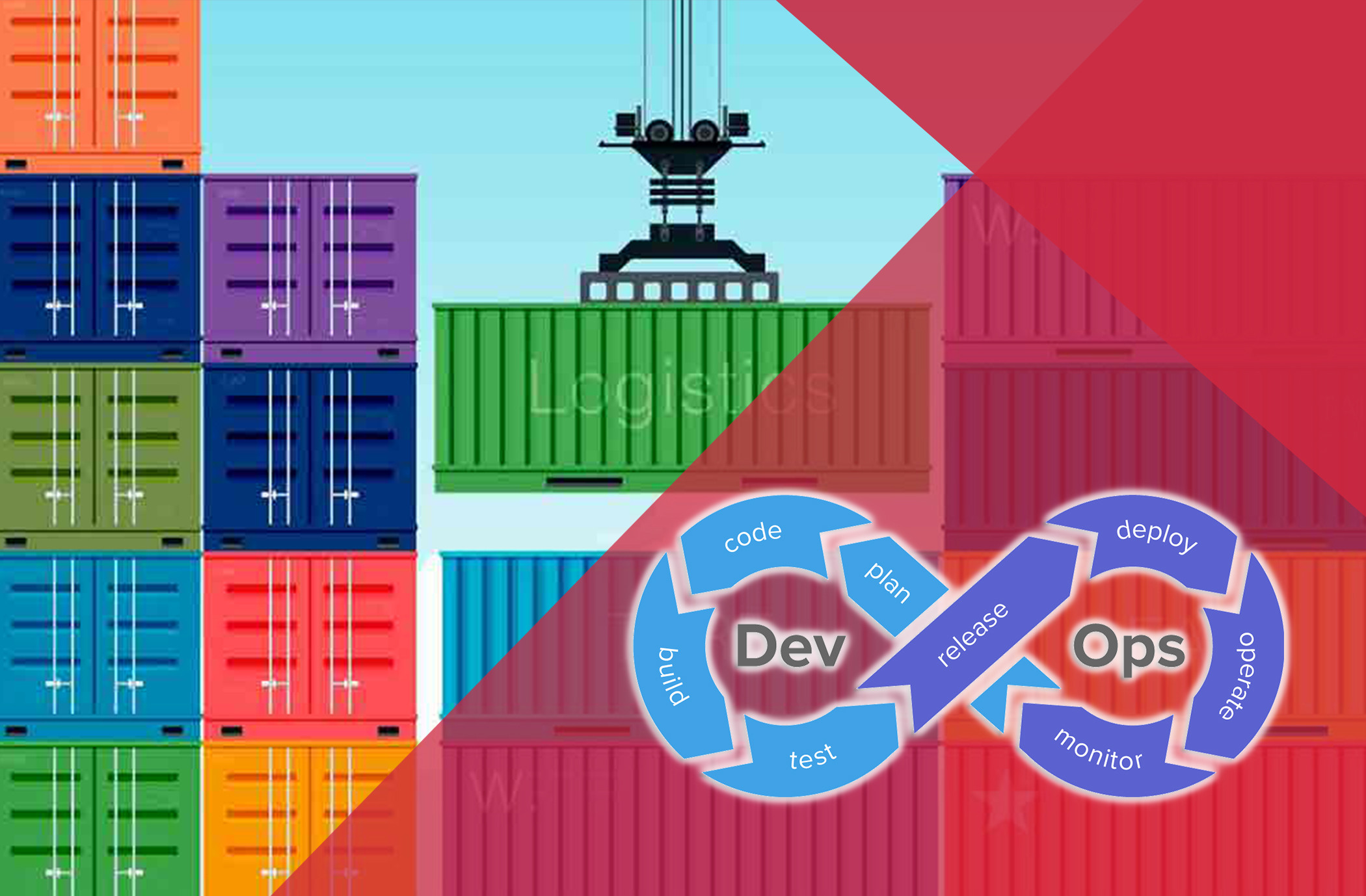
The world of technology continues with great advancement and innovation and DevOps and Containerization technologies are an example of this. Over the years they have developed new concepts and are the focus of the technical and operational areas, which seek agility, automation in management and reduction of time, advantages that the correct adoption of DevOps processes and the use of container technology.

Due to the increase and speed of technological leaps, the software market needs to produce high-quality results in a short time, increasing agility and limiting the number of life cycle errors (ALM). In this scenario, DevOps has the challenge of being part of the solution and overcoming the traditional problems of the IT areas: definition meetings, management of procurement and infrastructure processes, coupling of areas for the governance model, among others.

On the other hand, containerization technologies bring all the characteristics to simplify the application management process, allow portability between environments (on-premises – Cloud), and centralize the tasks of the operation teams, thus giving agility and mobility to the software, without losing sight of the implications of automation and management with DevOps.

The “everything as code” has been opening an important framework for the development of skills within the software cycle, which suggests incorporating scripting strategies within DevOps in order to optimize the way the included processes are automated.

We are going to involve these concepts to expose the benefits of the successful implementation of DevOps, taking innovation technologies hand in hand.

Phases of the 3HTP methodology

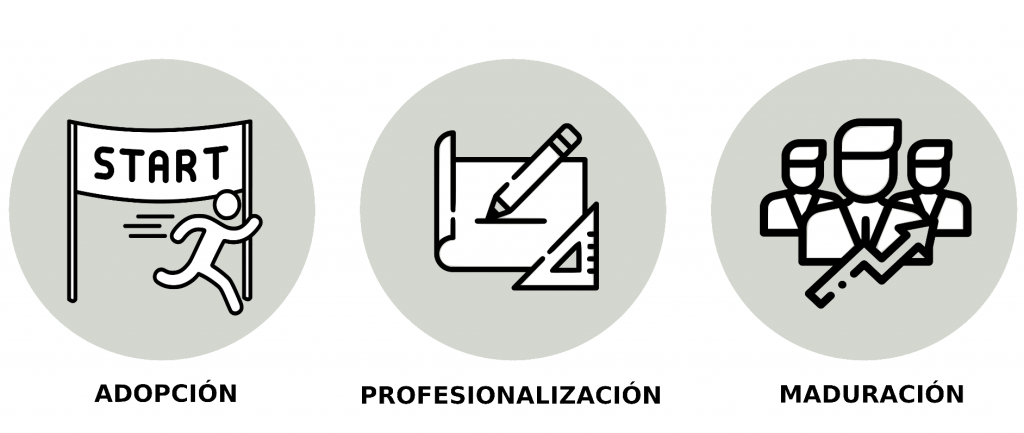
Within the adoption phase (first phase of the 3HTP methodology) it is important to transform the concepts of on-premises software installations and lead to dynamic models where solutions from infrastructure as code (Iac), application containerization, platforms as a service and script enablement participate. and/or plugins for the software execution of the toolchain; This is called Hybrid DevOps and what is known is the ability to define a faster implementation strategy.

In the DevOps Software market we find many solutions that offer these possibilities, but what is really important is to know how to define the tools that “contribute to my current business reality”, that is, that the analysis of the toolchain to be implemented is given by the scope it has each tool versus the functionalities that are needed in the objective outlined as an implementation roadmap.

Hybrid DevOps allows mixing these technology concepts to accelerate the step to professionalization (Phase 2 of the 3HTP methodology) and at the same time provide as an example automation measures, decrease in infrastructure costs, use of resources, and above all agility. We also find continuous integration engines that allow the execution of Jobs, with integration to automation tasks to the software and execution tasks of availability and provisioning of complete platforms for the applications.

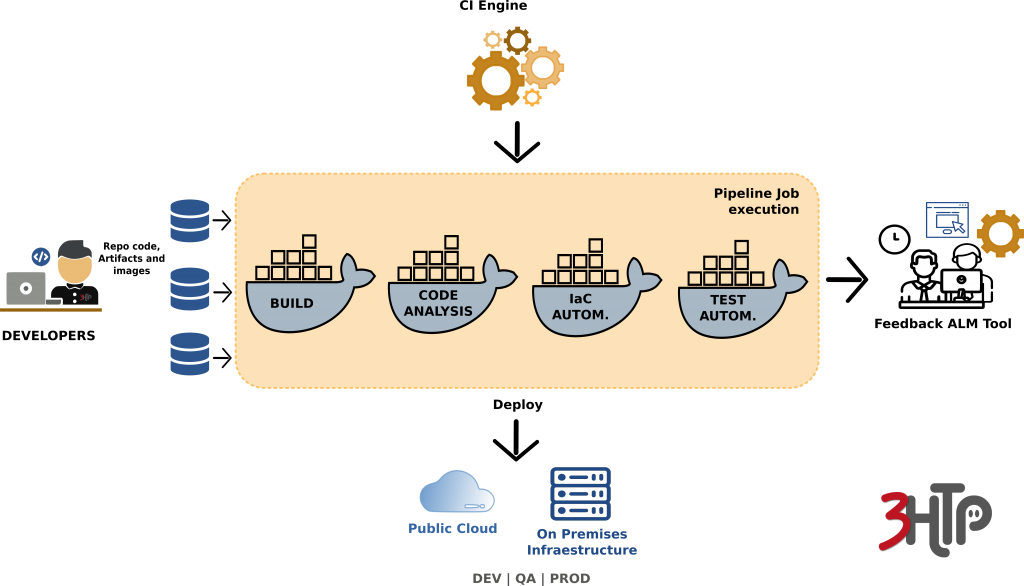
The diagram of the graph Nr2 shows an example of an implementation that could be given by different types of software solutions to contribute to the toolchain: The Artifact and Image Source repositories (now with the Containers trend) that are generally almost part of an asset for the company for its value and importance. On the other hand, a continuous integration engine with a pipeline that allows the execution of the DevOps phases to involve the creation of the container where the software that needs to be called to fulfill a task at a certain point in time (compilation, code analysis, unit tests, etc.), called infrastructure scripts as code, which allow the creation and provisioning of an environment, for example for the QA Testing phases, which are of “volatile” necessity and finally the call to scripts that automate a task by itself or by means of software. Finally, it also allows team collaboration and continuous improvement with feedback and feedback to the ALM solution, which could be software as a service (JIRA, VSTS, EWM, etc).

The speed of the Development teams and the technology area must be given by the implementation of solutions that contribute and give that speed that the market exists and that agility that is talked about so much. The adoption of technological tools today can be seen from different points of view and the use of resources is a vital part of the goals that IT has.

It is time to refocus the processes and adoption model, and launch into the management of a Hybrid DevOps architecture to meet the needs of the organization; It is time to increase the scripting skills of the teams involved in DevOps (Development, Testing, infrastructure, production) and start laboratories of these new solutions that help in the way of reducing time and costs.

In the next few years, DevOps faces optimizing and improving partitions that have been created in the middle phases of the CI / CT / CD / RM lifecycle process, and getting started delivering a tunnel (pipeline) that truly connects end to end. end-to-end Development with uninterrupted Operations and with the standards of Automation, quality, agility, security that the software and applications require.